Category Archives: Books

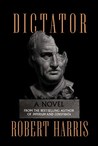
Review: Dictator

Dictator (Cicero, #3)Dictator by Robert Harris
My rating: 5 of 5 stars

Dictator is the third and final volume in the Cicero trilogy by Robert Harris. Dictator begins pretty much where the second volume Conspirata leaves off. This is the time of the First Triumvirate of Pompey, Crassus and Caesar, and the struggle to preserve the traditions of the Roman Republic. Cicero as an ex-consul is prominent among the opposition to the triumvirate.

You can easily Google Cicero and find out how the story ends, but in case you haven’t, there are some spoilers in the next two paragraphs.

Cicero’s strategy in opposition to the triumvirate is to try to divide them. As he knows and has worked with each of the three, he tries to play one off against the others. Given enough time, this might have worked, but Crassus dies during a campaign, and Caesar and Pompey go to war with each other. Cicero and most of the Senate favor Pompey – Caesar is far more dangerous to the Republic – but Caesar defeats Pompey who is later killed. Caesar then becomes the Dictator and Cicero bends with the wind and makes an accommodation with Caesar.

With Caesar’s victory in the civil war, the Roman Republic is on its last legs. Caesar does not rule wisely, to say the least, and an opposition group forms in the Senate, which includes Cicero, at least to some extent. He is not included in the group that eventually assassinates Caesar, though he does work with them to try to restore the structure of the Republic. The truth is that, as Cicero points out, the plotters did not plan for anything other than killing Caesar. This power vacuum leads to the rise of Marc Anthony, Octavian and Lepidus: the Second Triumvirate.

With the spoilers out of the way, this is an interesting period in Roman history, and through Cicero’s eyes we see again and again how power can corrupt. Cicero is not immune form this either as we have seen through the course of the trilogy, but his loyalty is to the Republic and he is not primarily concerned with increasing his own power at the expense of the Republic.

I enjoyed this book a lot. It’s a well-written conclusion to the trilogy, and even knowing how it ends, I still enjoyed reading the book. I definitely recommend this book if you are interested in this period of history.

Review: Conspirata

Conspirata: A Novel of Ancient RomeConspirata: A Novel of Ancient Rome by Robert Harris
My rating: 4 of 5 stars

Conspirata is the second volume of the Cicero trilogy by Robert Harris. It picks up where the previous volume Imperium leaves off, after the election of Cicero as on of the consuls of the Roman Republic. The book is divided into two parts, the first covers the year of Cicero’s consulship (63 B.C.) and the second part covers the four years after his term as consul.

The next paragraph contains some mild spoilers, so you may want to skip ahead.

As you might suspect from the title of the book, Cicero spends much of his consulship battling against a conspiracy that would fundamentally alter the structure of the Roman Republic. By the end of his year as consul, it seems that he has succeeded, and Cicero is hailed as the Father of the Republic. But, perhaps the conspiracy was deeper and more far-reaching than Cicero had believed. This is the subject of the second half of this volume.

This is an interesting period in the history of the Roman Republic, for it is in this time that the “First Triumvirate” – an alliance of Pompey, Crassus and Caesar – appears. The Triumvirate’s goal is not a greater Republic, but rather to enhance their own power and wealth. The politics of the wealthy elite appealing to the masses in the street, while gaining financial and political power, is not unlike the current politics in Europe and North America. Which again shows that there is no new thing under the sun.

I enjoyed this book a lot. It’s not quite as easy of a read as the first volume Imperium. It can be somewhat confusing to keep track of some of the minor characters, though thankfully the author has provided a glossary and a list of characters. If you’re interested in this period of history, this is a good book to read, though I would definitely recommend reading Imperium first.

Review: Imperium

Imperium (Cicero, #1)Imperium by Robert Harris
My rating: 5 of 5 stars

Imperium is a work of historical fiction set in the last years of the Roman Republic. The books is written as if Tiro, the slave and personal secretary to Marcus Cicero was writing a biography of his master. This novel follows Cicero as he enters the political life with the goal of being elected consul, which was the highest elected office of the Republic. Along the way we meet such historical figures as Pompey the Great and Crassus and Cato and even Julius Caesar.

One of the interesting things is that Tiro really did write a biography of Cicero but it disappeared with the fall of the Roman Empire. Tiro is also known for the invention of short-hand and it is through this mechanism that so many of Cicero’s speeches have been preserved.

Mr. Harris has done an excellent job of bringing this period, and some of the principal actors, to life. Cicero is completely dedicated to the Republic, but he is a “new man” and does not come from one of the old families and thus has to play the political game without a large fortune or the backing of the patricians.

I found the book to be a great read – very well written and quite informative about this period of Roman history. I knew who Cicero was but I really knew nothing about him as a person or a politician. It is also interesting how some aspects of politics have not changed in two thousand years! I have tried to avoid spoilers in this review, but it is easy enough for anyone to use Google to see if Cicero ever became consul.

So I heartily recommend this book. I should point out that it is the first book of a trilogy concerning Cicero. I’m looking forward to reading the others.

Review: Ike and McCarthy

Ike and McCarthy: Dwight Eisenhower's Secret Campaign against Joseph McCarthyIke and McCarthy: Dwight Eisenhower’s Secret Campaign against Joseph McCarthy by David A. Nichols
My rating: 4 of 5 stars

A very interesting book about an interesting period in US History. As we get farther away from the Eisenhower years (disclaimer: I was born during his second term), Ike’s reputation has been transformed. From the serene and distant grandfather who spent so much time on the golf course, we are seeing a more accurate portrayal of an involved chief executive who was quite adept at bureaucratic infighting if it was necessary to accomplish his goal.

One of the biggest complaints about Eisenhower was his silence on McCarthyism. In this book we see how Eisenhower actually responded to McCarthy: Ike basically refused to fight it out with McCarthy in the open because he believed that even mentioning him by name would increase McCarthy’s prestige. Instead Eisenhower worked behind the scenes to undermine McCarthy with the televised Army-McCarthy hearings delivering a fatal blow to McCarthy’s career. Eisenhower (and his subordinates) made some mistakes along the way – certainly Ike believed he erred by not defending General George Marshall earlier – but the behind the scenes plan worked, and virtually no one at the time suspected that Ike had anything to do with McCarthy’s downfall.

The author has done a good job of combining multiple stories and points of view to show Eisenhower in action against McCarthy. There are many footnotes to primary and secondary sources; this is the way that history should be written. If you’re interested in this period of history, I highly recommend this book.

Review: The Once and Future King

The Once and Future KingThe Once and Future King by T.H. White
My rating: 5 of 5 stars

I love this book. I read it for the first time when I was in high school in the 1970s, and I re-read it every year or two through my twenties, but then didn’t pick it up again until this year, 30+ years later. Reading it again after all this time was like meeting a long-lost friend.

The book is a re-telling of the story of Arthur and the Round Table. If you’ve seen “Camelot” or even “Monte Python and the Holy Grail” you know the basics of the story. The author follows Sir Thomas Malory’s “Le Morte d’Arthur” though he focuses much more on Arthur, Lancelot and Guinevere. So the plot is literally nothing new, but it is the way the story is told that makes this my favorite book. It’s a compelling story, re-told here with humor, emotion and many amusing anachronisms. The story is about love and friendship but also about humanity, religion, politics and power.

It’s a long book, divided into four sections, but it’s easy to read. I strongly recommend it.

Review: Prussian Blue

Prussian Blue (Bernie Gunther, #12)Prussian Blue by Philip Kerr
My rating: 4 of 5 stars

This is the latest Bernie Guenther novel from Philip Kerr and it contains two parallel stories, one set in October 1956 and the other set in April 1939. The 1956 thread begins as a continuation of the story in the previous novel “The Other Side of Silence.” It’s hard to go into too much detail without generating spoilers for either of the novels, but in 1956 as the season on the Riviera comes to a close, Bernie is visited by some former acquaintances who now work for the East German Stasi. They request his assistance in wrapping up a few of the loose ends from “The Other Side of Silence.” One of the Stasi men worked with Bernie on an interesting case in 1939, involving a murder in Berchtesgaden shortly before the celebration of Hitler’s 50th birthday.

While investigating the murder in 1939 Bernie uncovers several rings of corruption centered around Martin Bormann and his operations in the area. Bormann has built the “Eagles Nest” (or the Kehlsteinhaus) as a present to Hitler for his birthday, but if there is a murderer on the loose, Hitler will not come to Berchtesgaden and Bormann’s power will be diminished. So the pressure is on Bernie to catch the killer and do it quickly.

The two threads converge in an interesting way. Both stories are well done and are quite interesting. I will say Bernie seems a bit tired in 1956 and makes some mistakes. It’s a very entertaining read and I recommend this book.

Review: Conclave

ConclaveConclave by Robert Harris
My rating: 4 of 5 stars

I’ve read and enjoyed several of Robert Harris’s novels and so I was intrigued by the idea of a thriller set in a papal conclave. The story is told from the perspective of Cardinal Lomeli who as the Dean of the College of Cardinals runs the conclave after the death of the pope. There are scandals and political maneuvering and pressure to choose the new pope quickly.

It is a well-imagined and well-told story. The author has obviously done his research. There are plenty of twists and turns along the way. And there is a major twist right at the end that I certainly did not see coming. I enjoyed reading this book and I recommend it.

Review: A Hero of France

A Hero of France (Night Soldiers, #14)A Hero of France by Alan Furst
My rating: 4 of 5 stars

This is the latest novel in the “Night Soldiers” series from Alan Furst. I believe that this is the first one set in Occupied France, and it’s a fairly good story about a resistance cell led by a man named Mathieu. We don’t really learn how this resistance group came into being, but the action begins in March 1941 and we meet most of the organization as they help RAF crew members who were shot down over France return to the UK.

We also see the German and Vichy French attempts to break the various Resistance organizations, and also the British begin to both support and direct the activities of the Resistance.

To avoid spoilers i won’t really go into to any details of the plot. It is a good read and I enjoyed the book. I think it is better than the last couple of books in the series, but not as good as some of the earlier ones.

Review: What Ifs of American History

What Ifs? of American History: Eminent Historians Imagine What Might Have BeenWhat Ifs? of American History: Eminent Historians Imagine What Might Have Been by Robert Cowley
My rating: 3 of 5 stars

I enjoy reading alternative history fiction, it’s one of my favorite genres. So this collection of “What if?” stories focusing on the United States seemed like a good fit for me. The book is a good read and some of the essays are quite thought provoking, such as the one concerning Senator Joseph McCarthy. But these are really essays on what could have happened at various points in the history of the United States and not truly stories set in an alternative history.

I do recommend this book if you are interested in American History, but if you are really looking for alternative history fiction you will probably be a little disappointed with this collection of essays.

Review: Blood Brothers

Blood Brothers: The Dramatic Story of a Palestinian Christian Working for Peace in IsraelBlood Brothers: The Dramatic Story of a Palestinian Christian Working for Peace in Israel by Elias Chacour
My rating: 5 of 5 stars

I really liked this book. It’s the autobiography of Elias Chacour a Palestinian Christian living in the Galilee area. He was a young boy when Palestine was partitioned followed shortly by the formation of the State of Israel and the war of 1948. The area in which the Chacours lived became part of Israel and they were forced to leave their village. Elias eventually went to school in Haifa and then to a seminary and became a priest.

It is an amazing story and Chacour presents a view of the history of the Middle East that is not often seen or heard. But beyond the first person description of how the Six Day War, for example, affected the Christian and Palestinian communities, it’s also the story of Chacour putting aside his anger and becoming a servant of God. I think everyone who is thinking about becoming a priest or a pastor should read the chapter about his first church assignment!

This is a compelling story and well worth reading. Chacour’s work for peace between the Palestinians and Israelis is based on a bottom up view of the process: people from different backgrounds getting to know each other and learning to live together. I highly recommend this book.