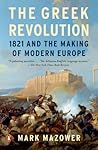
 The Greek Revolution: 1821 and the Making of Modern Europe by Mark Mazower
My rating: 5 of 5 stars
The Greek Revolution is a comprehensive look at the struggle for the independence of Greece. It is a complicated story, to say the least, and the author does a very good job of explaining what happened and why. There are a lot of aspects to the story, but one that struck me was right at the start: who is Greek? That is, what sets the Greek people apart from the other ethnic groups in the Ottoman Empire? It was not always an easy question to answer.
The story begins with the end of the Napoleonic Wars and the Congress of Vienna. With the restoration of the Bourbons in France and the formation of the Holy Alliance, the major powers were conservative, and unlikely to support any changes to the status quo in Europe, whether among the Italian states or in the Ottoman borderlands. But a secret society, Etaireia, was formed by some Greeks looking to secure independence for Greece. And so it begins.
The armed struggle began in 1821, and the Greek forces had a lot of initial success, especially in the islands and on the Peloponnesian peninsula. But the Greek efforts were complicated by the lack of a strong central government; most of the local chieftains and notables were in it for themselves and the provisional government was not strong enough to compel them to obey. The result was a civil war.
I’m not going to summarize the rest of the story – not because of spoilers, but because it would take up too much space. There are many battles and sieges, an invasion from Egypt. There are volunteers from across Europe who join the Greek forces; Lord Byron is probably the most famous. And there are massacres, and mistreatment of the civilian population on both sides. This eventually prompts the powers – the UK, France and Russia – to intervene by sending naval squadrons to Greece. At the battle of Navarino, the combined fleet crushed the Ottoman fleet, in the last major battle between sailing ships.
The Great Powers victory at Navarino eventually leads to an independent Greece in 1828, with all three of the powers guaranteeing Greek independence. Of course, the new Greece was much smaller than it is now, but as the Ottoman Empire declined, other areas were annexed by Greece.
I really liked this book a lot. It is comprehensive and has good footnotes and suggestions for further reading. I knew the basics of the Greek Revolution, courtesy of an Intro to Modern Europe history class, but this book really explains what happened and how it came about. It’s not an easy read because there is a lot of detail, but it’s well worth the effort.

 Frankenstein by Mary Wollstonecraft Shelley